All-in-One AI-powered-CRM vs. Best-of-Breed Stack
For years, growing businesses were told to pick the best tool for each job. In 2026, tool sprawl, API breakdowns, and monthly software bills are quietly killing SME profit margins. Discover why consolidating into an All-in-One AI CRM is the ultimate strategic move.
Key Takeaway for Business Owners
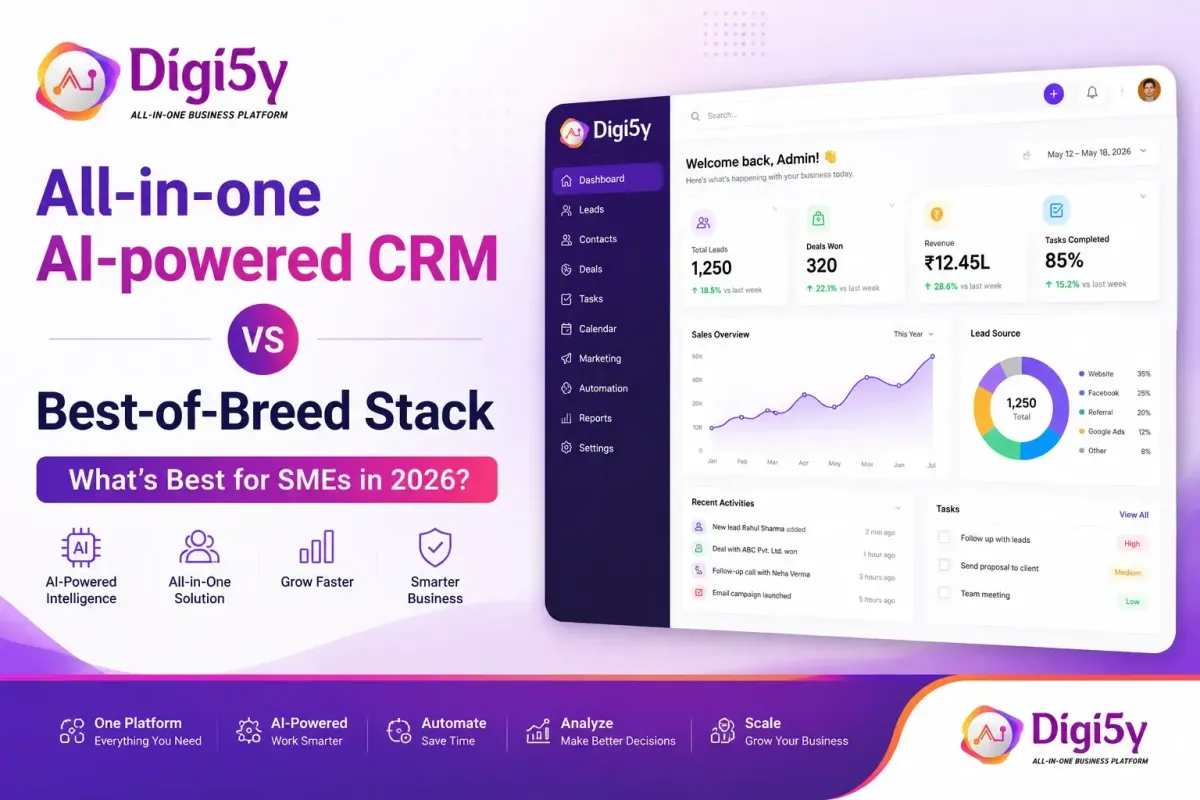
For years, SMEs were told to buy specialized tools for every task. In 2026, tech stack fragmentation costs small businesses thousands monthly in licensing fees, API breakdowns, and lost leads. Here is the comprehensive breakdown of All-in-One AI CRM vs. Best-of-Breed stacks.
The debate between choosing a single unified AI CRM platform and assembling a best-of-breed software stack has reached a tipping point. In 2026, the hidden tax of tool sprawl is quietly destroying SME profit margins.
All-in-One AI-powered CRM vs. Best-of-Breed Stack: Which architecture delivers real ROI for growing SMEs in 2026?
The Great Tech Stack Illusion: How We Got Here
A decade ago, the tech industry preached a compelling philosophy: 'Best-of-Breed'. The logic sounded bulletproof to business owners and IT managers alike. If Mailchimp was the undisputed leader in email newsletter delivery, Salesforce led enterprise sales tracking, Calendly handled scheduling flawlessly, and Zapier bridged the gaps, why would any rational business choose a single platform that claimed to do everything?
The promise was specialization. Point solutions poured millions into perfecting single features. A niche booking widget felt slicker than a built-in calendar. An isolated review collection tool had prettier widgets. Business owners dutifully signed up for $49/month here, $99/month there, $199/month for CRM, and another $299/month for automation middleware.
Fast forward to 2026. What felt like an agile toolkit has transformed into an operational nightmare. The average small-to-medium enterprise (SME) now maintains between 8 and 14 separate SaaS subscriptions. What was promised as flexibility has turned into brittle data silos, constant Zapier error notifications, multi-login chaos, and ballooning monthly software invoices.
"When you string together 8 different software platforms with webhooks and Zapier, your customer data doesn't flow — it leaks. Every connection point is a potential point of failure where qualified leads disappear into thin air."
The Unspoken Costs of the Best-of-Breed Stack
Most business owners evaluate software costs purely by looking at recurring monthly subscription fees. But in a best-of-breed stack, the listed price is only a fraction of the true total cost of ownership (TCO). Let's examine the four hidden taxes that best-of-breed stacks impose on growing SMEs:
1. The Integration Breakdown Tax (API Fragility)
Every time a third-party tool updates its API schema or revokes an OAuth token, connected workflows stop functioning. A lead submits a form on your landing page builder, but because the Zapier integration silently errored due to a rate limit, the record never reached your CRM. No alert is triggered; you simply discover two weeks later that 15 warm prospects were never contacted.
2. The Context Switching & Productivity Tax
When an employee has to log into one tool to check a calendar, another to read a WhatsApp message, a third to check email history, and a fourth to create an invoice, cognitive load skyrockets. Research shows that context switching between disconnected apps costs workers up to 4 hours per week in lost momentum and manual data re-entry.
3. The Data Fragmentation & Disconnected Customer Journey Tax
In a fragmented stack, customer interactions are scattered across isolated islands. Your email marketing tool doesn't know that a prospect just had a 20-minute phone call with sales. Your SMS tool sends a discount code to a client who cancelled yesterday because the status update hasn't synced across platforms. Customers receive disjointed, repetitive, or contradictory messages.
4. The Subscription Creep Tax
Software point solutions rely on tier-based pricing triggers — charging more when contact thresholds or feature limits are reached. What started as a modest $300/month stack quickly escalates to $1,800 or $2,500/month as your contact list expands, even if revenue hasn't grown proportionally.
💰 Tech Stack Cost Real-Check
Average SME Best-of-Breed Monthly Expense in 2026
CRM ($150) + Email Marketing ($120) + SMS Platform ($90) + Appointment Scheduler ($30) + Funnel/Landing Page Builder ($297) + Review Management ($199) + Social Media Scheduler ($60) + Automation Middleware ($125) = $1,071/mo ($12,852/year) for basic functionality across 8 separate dashboards.
The 2026 Shift: How Modern All-in-One AI CRMs Rewrote the Rules
The main historical criticism of all-in-one platforms was that they were 'jacks of all trades, masters of none'. In 2018, an all-in-one system might have offered email marketing, but it lacked basic automation branching. It had a calendar, but it couldn't sync bidirectionally with Google Calendar.
By 2026, AI and modern cloud architectures completely eliminated this trade-off. All-in-one AI CRM platforms like DIGI5Y haven't just caught up to point solutions — they have leapfrogged them by embedding autonomous AI agents directly into the underlying database core.
- 8–12 separate software subscriptions & logins
- Relies on Zapier/webhooks that silently fail
- Data scattered across disconnected silos
- Manual data entry & copy-pasting between apps
- No unified AI agents that see the entire client history
- Costs $1,200–$2,500+ per month in combined fees
- 1 single platform replacing up to 10+ subscriptions
- Native direct data flow without external middleware
- Single customer record for Email, SMS, WhatsApp & Voice
- Autonomous AI agents handle 24/7 lead qualification
- Omnichannel inbox with full conversation timeline
- Flat predictable pricing saving up to 80% on software
5 Structural Advantages of an All-in-One AI CRM System
1. Zero-Latency Trigger Automation
When all features share a native database, actions trigger instantly. The moment a contact fills out a lead form on a DIGI5Y landing page, an AI voice agent can initiate a phone call within 15 seconds, while simultaneously tagging the CRM contact, firing a WhatsApp confirmation, and logging the event in your analytics dashboard — all without a single API call.
2. Omnichannel Unified Conversations
In an all-in-one CRM, every communication stream — Email, SMS, WhatsApp, Google Business Chat, Facebook Messenger, Instagram DMs, and Web Live Chat — aggregates into a single unified inbox. Your team (or your AI agent) can view the complete, chronological conversation history regardless of which channel the customer chooses to reply on.
3. Context-Aware AI Workforce
Standalone AI widgets on point solutions are blind to context. An isolated AI chatbot on a website doesn't know if a visitor is an existing client with a pending invoice or a brand-new prospect. An AI agent embedded in an all-in-one CRM accesses full pipeline data, past booking history, and recent email exchanges, enabling human-grade conversational intelligence.
4. Unified Monetisation & Invoicing
Instead of exporting CRM deals to a separate billing tool, an all-in-one system generates estimate proposals, collects e-signatures, processes credit cards or Stripe payments, and sets up recurring subscriptions directly inside the deal workflow.
5. Single-Point Governance & Security
Managing user permissions across 10 different apps is a security vulnerability waiting to happen when employees join or leave the company. An all-in-one platform allows role-based access control (RBAC) managed from a single administrative panel.
Performance Benchmarks: Side-by-Side Comparison
Who Should Still Use Best-of-Breed in 2026?
While consolidation is the optimal path for 90% of SMEs, objectivity requires acknowledging where specialized stacks still make sense:
- Large Enterprises with 500+ Employees: Enterprise organizations with dedicated DevOps, Salesforce architects, and custom data engineering departments.
- Niche Regulatory Compliance: Businesses operating under extreme regional healthcare or banking data residency laws that mandate specialized local software.
- Complex High-Volume E-Commerce: Brands managing 100,000+ SKUs with complex warehouse logistics that require specialized ERPs like SAP or custom Shopify Plus setups.
However, for service-based businesses, local clinics, agencies, consultants, real estate firms, contractors, and growing SMBs under 50 team members, an all-in-one AI CRM provides far superior agility, speed, and profitability.
The Migration Playbook: How to Consolidate Without Friction
Switching from a fragmented stack to a unified platform doesn't have to disrupt daily operations. DIGI5Y recommends a streamlined 3-step transition:
- Step 1: Audit Your Software Subscriptions: List every recurring software bill, active user licenses, and current Zapier connections.
- Step 2: Consolidate Database & Inbound Channels: Import contact records, clean duplicate emails, and connect domain DNS for Email, SMS, and WhatsApp.
- Step 3: Activate AI Agents & Core Automations: Turn on instant lead response, automated appointment scheduling, and Google review request workflows.
Frequently Asked Questions
Frequently Asked Questions
Will I lose specialized features if I switch from a standalone email tool to an All-in-One AI CRM?
No. Modern All-in-One platforms like DIGI5Y feature enterprise-grade visual email builders, split testing, automated sequence triggers, domain warm-up tools, and high deliverability infrastructure that match dedicated email marketing platforms.
How long does it take to migrate from a best-of-breed stack to DIGI5Y?
Most SMEs complete full migration within 5 to 10 business days. DIGI5Y provides guided onboarding, contact import tools, and dedicated Remote Digital Specialists to handle technical setup if required.
Can DIGI5Y still connect to external custom apps if needed?
Yes. While DIGI5Y includes native tools for CRM, SMS, Email, Forms, Funnels, and Calendars, it also maintains robust open APIs and webhook support for specialized external integrations.
What is the financial ROI of replacing 8 tools with DIGI5Y?
The average SME saves $800 to $2,000+ per month in software subscription fees alone, while increasing lead conversion rates by up to 391% due to sub-60-second automated response times.
Key Takeaways
- Best-of-Breed stacks force SMEs to manage 8–14 separate tools, resulting in broken integrations, scattered data, and subscription fatigue.
- All-in-One AI CRM platforms in 2026 have eliminated the quality trade-off, offering enterprise-level CRM, marketing automation, AI agents, and scheduling in one place.
- Native zero-latency automation ensures leads are responded to in under 60 seconds, boosting conversion probabilities by up to 391%.
- Consolidating software saves growing businesses between $10,000 and $25,000 annually in subscription and maintenance costs.
- A single customer record across all channels gives AI agents the context needed to qualify leads, book appointments, and handle support flawlessly.
Stop paying for 8 separate tools when one connected system can run your entire business. Discover how much you can save and unlock with a free 10-minute GrowthScore audit or book a live Discovery Call today.
Read Next: Popular Growth Playbooks

Get the AI Edge Delivered Weekly.
Join 12,000+ founders and operators getting our freshest business automation software playbooks, AI employee agents news, and revenue-boosting hacks — straight to your inbox. No fluff. Just growth.