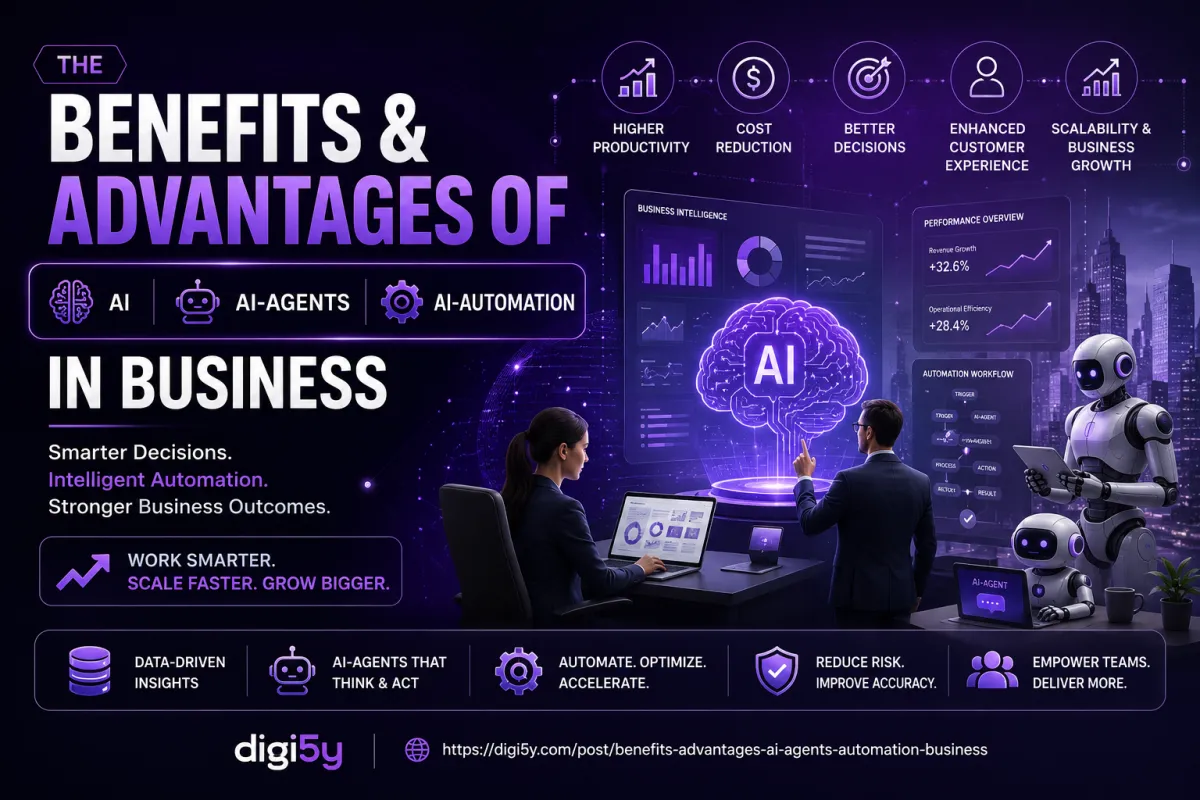
AI Agents & Automation for Business Growth: Benefits & DIGI5Y | 2026
The AI revolution is not coming. It is already here, and the businesses that understand this are pulling so far ahead that the gap may soon be impossible to close.
Right now, in every industry, a quiet transformation is underway. Some businesses are running AI agents that respond to customers at 2 am, qualify leads before a salesperson wakes up, generate content while the marketing team sleeps, and analyse performance data in real time, all without a single additional hire.
Their competitors are still manually following up on enquiries, paying rising wages for repetitive work, struggling to find the right talent, and wondering why growth feels harder than it should.
This is not a technology story. It is a business story. And this post is the honest, detailed case for why AI agents, AI employees, and intelligent automation are now the single most important investment any business can make, and what happens to those who wait too long to act.
The Real Pain Points Holding Businesses Back, And Why Traditional Approaches Are Failing
Before we talk about the solution, let us be honest about the problem. Because the challenges facing most businesses today are real, significant, and getting worse, not better.
The Talent Shortage Is Not Getting Easier
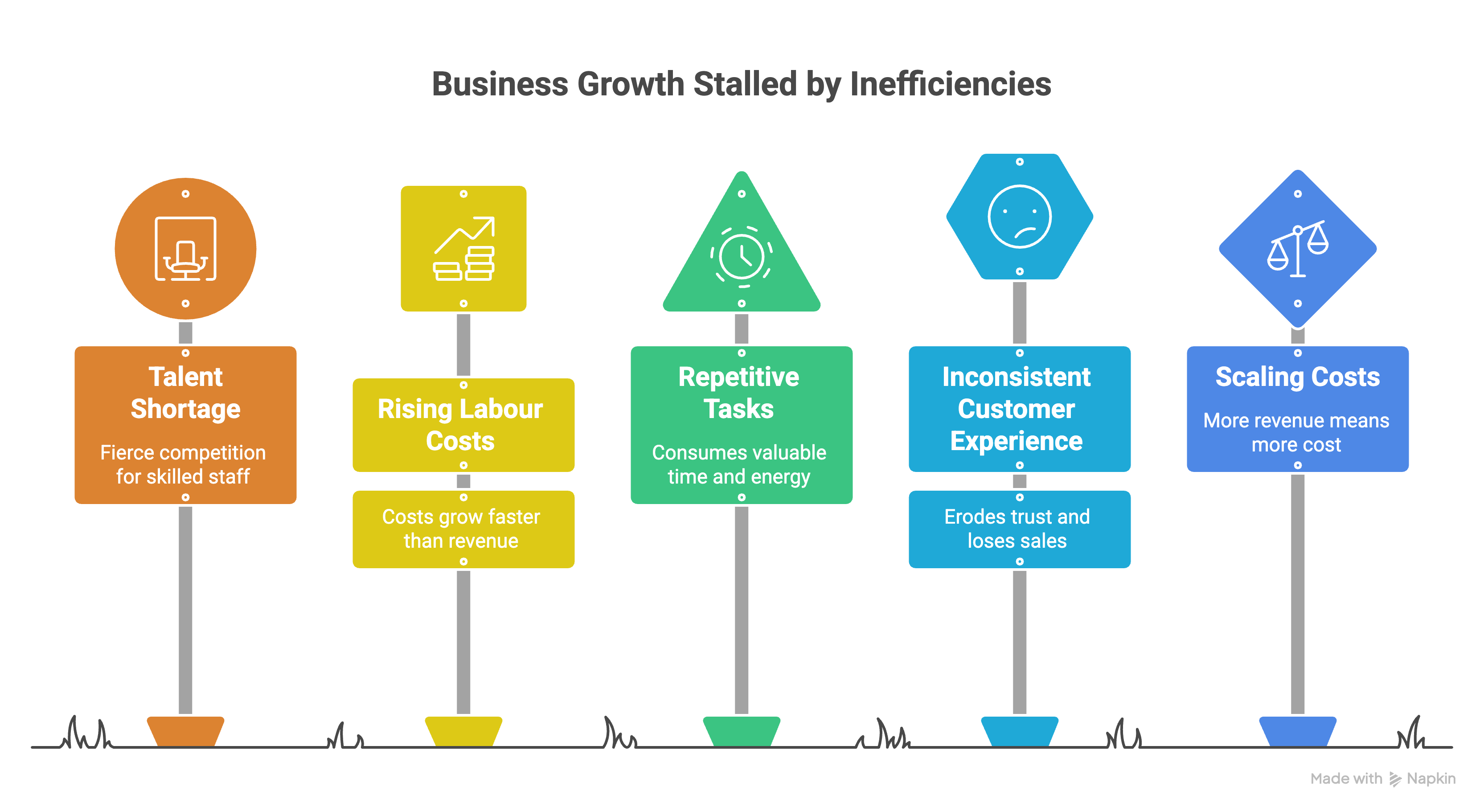
Finding great people has never been harder. The competition for skilled staff in digital marketing, customer service, sales, administration, and technical roles is fierce. Recruitment takes months. Onboarding takes more months. And just when someone is fully productive, they leave for a competitor offering more money or flexibility.
The result: businesses are chronically understaffed in the roles they need most, perpetually behind on the tasks that drive growth, and spending enormous energy on hiring and rehiring the same positions repeatedly. According to the Society for Human Resource Management (SHRM), the average cost to replace an employee is six to nine months of their salary. For a $60,000 role, that is $30,000–$45,000 in direct replacement cost — before you account for lost productivity and institutional knowledge.
Labour Costs Are Rising Faster Than Revenue
Minimum wages are increasing across nearly every developed economy. Benefits packages are expanding. Employer taxes are growing. And the cost of hiring experienced professionals in areas like digital marketing, analytics, and customer experience has skyrocketed as demand for these skills outpaces supply.
For most SMEs, labour is already the largest single line item on the P&L — and it is growing. Yet every new hire adds only so much capacity. The traditional model of "grow revenue by adding people" produces diminishing returns at precisely the moment when margin pressure is greatest.
Repetitive Tasks Are Consuming Your Most Valuable Resource
Study after study confirms what every business owner already suspects: a significant portion of every working day — in every role, at every level — is consumed by tasks that are repetitive, manual, and fundamentally low-value. Answering the same FAQs. Sending the same follow-up emails. Updating the same spreadsheets. Booking the same types of appointments. Requesting the same reviews.
McKinsey estimates that 45% of work activities could be automated using technology that already exists today. That is nearly half of everything your team does — every day — that could be handled by an AI agent instead. The cost of not automating these tasks is not just financial: it is the creative energy, strategic thinking, and relationship-building capacity that never happens because your people are buried in admin.
Inconsistent Customer Experience Is Costing You Sales
Customers expect consistency. They expect fast responses. They expect the experience to be the same whether they reach out on Monday morning or Saturday evening, whether they speak to your most experienced team member or your newest hire. Manual processes cannot deliver this. Human variability guarantees inconsistency. And inconsistency — in response time, in tone, in information provided — erodes trust and loses sales.
Scaling Without AI Means Scaling Costs — Not Just Revenue
The most frustrating thing about growing a business the traditional way is that more revenue almost always means proportionally more cost. More customers mean more customer service staff. More leads mean more salespeople. More content means more marketers. The ratio never really improves because the work itself scales linearly with the number of people doing it.
AI breaks this equation entirely. And that is one of the most profound business opportunities of the current era.
What Exactly Are AI Agents and AI Employees? A Plain-English Explanation
Before exploring the benefits, it is worth being precise about what we mean — because "AI" has become such a broad term that it risks losing all meaning.
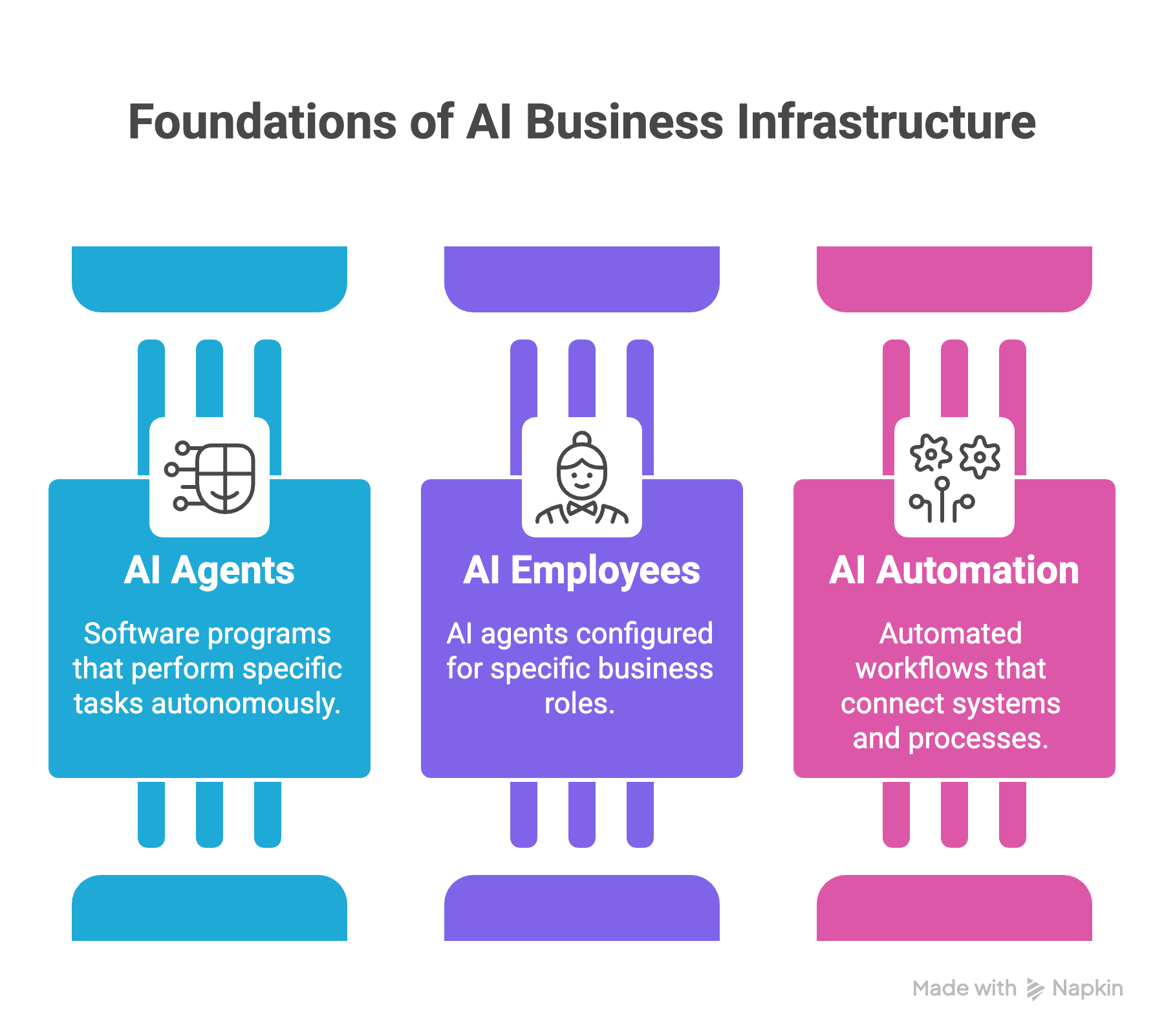
AI Agents are software programmes powered by large language models and machine learning that can carry out specific, goal-directed tasks autonomously. They can engage in natural conversation, make decisions, take actions, and adapt based on context — without a human directing every step.
AI Employees are purpose-built AI agents configured to perform specific business roles continuously — a customer service representative, a sales qualifier, a receptionist, a marketing manager, a reputation monitor. They do not have an off switch. They do not call in sick. They do not need to be managed, motivated, or retained. They simply do the job they are built to do, all day, every day.
AI Automation refers to the broader infrastructure of automated workflows that connect systems, trigger actions, and execute processes based on rules and conditions — without manual human input at each step. Think of it as the nervous system that connects your AI employees and to your business operations.
Together, these three elements create a business infrastructure that operates with a level of consistency, speed, and scalability that simply cannot be achieved with human labour alone.
Benefit 1: 24/7 Availability — Your Business Never Closes Again
"While your team sleeps, your AI employees are working. Every lead is answered. Every question is addressed. Every appointment is booked."
This is perhaps the single most transformative benefit of AI agents — and the one most businesses underestimate until they see the data.
The modern customer does not observe business hours. They enquire when it is convenient for them — often evenings, weekends, and public holidays. A prospect who submits an enquiry at 10 pm and receives a response at 9 am the next morning has already had 11 hours to find an alternative. In most categories, they have.
What 24/7 AI availability delivers:
AI Chat Agents engage every website visitor instantly — answering FAQs, qualifying interest, and capturing contact details — at any hour, on any device
AI Voice Agents answer every inbound call with a professional, natural-sounding response — capturing caller intent, providing information, and booking appointments even when the office is closed
WhatsApp and SMS AI Agents engage leads on the channels they prefer most, with personalised, contextual responses that feel human — not robotic
Simultaneous capacity — Unlike a human receptionist, an AI agent handles unlimited concurrent conversations. Peak demand does not mean dropped balls
Illustration: A medical aesthetics clinic was missing 35% of enquiries that came in after 6pm. After deploying an AI chat and voice agent, every after-hours enquiry received an immediate, professional response. In 60 days: 41% more appointments booked. Zero additional staff. Zero overtime.
Benefit 2: Dramatic Cost Reduction Without Sacrificing Output Quality
"AI does not replace the value your team creates. It replaces the cost of doing the work that does not require human creativity, judgement, or empathy."
The financial case for AI employees is, frankly, extraordinary. Consider what it actually costs to employ a human in a customer-facing or administrative role: salary, employer taxes, benefits, sick leave, annual leave, training, management time, equipment, desk space. In most developed markets, the total cost of an entry-level customer service or administrative role is $45,000–$75,000 per year.
An AI agent performing the same function — 24 hours a day, 365 days a year, handling unlimited volume — costs a fraction of that. Not a slightly better deal. A fundamentally different cost structure.
Where AI delivers the greatest cost savings:
Customer support — AI handles tier-1 queries (FAQs, order status, appointment changes, basic troubleshooting) automatically, passing only complex cases to human staff. Most businesses find 60–70% of all support queries can be resolved by AI without any human involvement
Lead response and qualification — An AI sales agent responds to every new lead within seconds, qualifies their interest, and filters out non-buyers — delivering only high-quality, ready-to-convert prospects to your sales team
Marketing and content — AI generates first drafts of email campaigns, social media posts, blog content, and ad copy — dramatically reducing the hours spent on content creation without compromising quality
Data entry and administration — AI reads, categorises, and enters data automatically — eliminating one of the most common and expensive uses of human administrative time
Illustration: A financial services firm replaced two full-time administrative roles with an AI agent handling client onboarding, document requests, and appointment scheduling. Annual saving: $112,000. Client response times improved from 6 hours to 4 minutes.
Benefit 3: Eliminate Repetitive Tasks — Liberate Your Team for High-Value Work
"Your best people were not hired to send follow-up emails and update spreadsheets. Give them back the time to do what only humans can do."
There is a profound cost to repetitive work that does not appear on any P&L statement: the opportunity cost of the high-value work that never happens because your best people are buried in tasks that a machine could do.
When a skilled salesperson spends two hours a day manually entering CRM data and sending follow-up emails, that is two hours they are not spending building relationships, closing deals, and generating revenue. When a marketing manager spends half their week scheduling social posts and drafting routine email sequences, that is time not spent on strategy, creativity, and the work that actually differentiates your brand.
Repetitive tasks AI automation eliminates:
Lead follow-up sequences (email, SMS, WhatsApp) — triggered automatically based on behaviour
Appointment confirmations, reminders, and rescheduling — fully automated, zero manual input
Review requests after every completed service — sent automatically, timed perfectly
Social media scheduling and publishing — planned once, published consistently
CRM data entry and contact updating — populated automatically from lead sources
Invoicing triggers and payment reminders — connected to pipeline stage completion
Reporting and performance summaries — generated and delivered automatically on schedule
Illustration: A real estate agency automated their entire lead nurture sequence — 7 touchpoints over 21 days, across email and SMS. Their agents went from spending 3 hours daily on follow-up to zero. Lead-to-appointment conversion increased 28% because the follow-up was now consistent — not dependent on whether an agent remembered.
Benefit 4: Instant, Consistent Customer Experience at Scale
"AI does not have bad days. It does not forget to follow the script. It delivers the same quality of experience to customer number 1 and customer number 10,000."
Customer experience is the most important competitive differentiator in most markets — and it is also the hardest thing to deliver consistently at scale when that experience depends entirely on human behaviour.
People are inconsistent. They have off days. They rush through conversations when busy. They forget steps. They interpret "standard process" differently. The result: a customer experience that varies depending on who answered the phone, how busy the team was, and what mood prevailed in the office that morning.
AI agents do not have this variability problem. They follow the same process, in the same order, with the same quality of communication — every single time. Combined with personalisation powered by CRM data, they can deliver responses that feel genuinely tailored without the inconsistency of human execution.
What a consistent AI-delivered customer experience looks like:
Every new lead receives the same quality, speed, and professionalism of initial response — regardless of time of day or team workload
Every customer receives the same structured onboarding sequence — no steps skipped, no information missing
Every post-service touchpoint — review request, satisfaction check, upsell offer — fires at the right time, every time
Every FAQ is answered accurately and completely — no partial information, no "I'll get back to you on that"
Illustration: A hospitality group with 12 properties implemented an AI customer service agent across all locations. Guest enquiry response time standardised to under 90 seconds across all properties. Guest satisfaction scores increased by 19 points in 90 days — not because the product changed, but because the experience became reliably excellent.
Benefit 5: Speed That Creates Competitive Moats
"The business that responds in 60 seconds is not just faster than the one that responds in 6 hours. It is playing a different game entirely."
Speed is not just a nice operational metric. It is a sales lever, a trust signal, and increasingly a customer expectation that, when unmet, ends the consideration of your business before it has properly begun.
Research consistently shows that the probability of contacting a lead drops by over 10 times if you wait longer than one hour to respond. After 24 hours, most leads have already decided on an alternative. The businesses winning in high-competition markets are the ones with AI in the response loop — responding in seconds, not hours.
Where AI speed delivers the greatest competitive advantage:
Lead response — AI contacts every new enquiry within 60 seconds, day or night, across whatever channel the lead used
Quote and proposal delivery — AI-generated proposal drafts, personalised to enquiry details, delivered in minutes rather than days
Support resolution — Tier-1 support issues are resolved instantly, not after a 48-hour ticket queue
Appointment booking — AI books directly into the calendar without back-and-forth scheduling emails
Data insights — AI surfaces performance trends in real time, not in a monthly report that is already out of date by the time it is read
Illustration: Two competing law firms received enquiries from the same prospect 4 minutes apart. Firm A responded within 90 seconds via AI chat — qualified the prospect, answered initial questions, and offered a consultation booking link. Firm B called back 4 hours later. The prospect had already booked with Firm A.
Benefit 6: Intelligent Automation, Workflows That Think and Adapt
"The most powerful automations are not the ones that replace tasks. They are the ones that replace decisions."
Basic automation follows simple rules: if this happens, do that. Intelligent automation powered by AI goes further: it analyses context, interprets intent, and makes nuanced decisions that previously required human judgement.
A lead who opens three emails but has not booked a call is treated differently from one who has never opened anything. A customer who raises a complaint is escalated to a human immediately — with full context — rather than continuing through an automated sequence that would feel tone-deaf. A prospect who visits the pricing page three times triggers a different follow-up than one who only reads the blog post.
What intelligent AI-driven workflows make possible:
Behavioural triggers — Actions based on what contacts actually do, not just what they are tagged as
Lead scoring — AI evaluates engagement signals and ranks leads by conversion probability, so your team always knows who to prioritise
Dynamic personalisation — Email sequences, chatbot responses, and follow-up messages that adapt based on the contact's history, segment, and behaviour
Conditional branching — Workflows that fork based on outcomes — if they book, this path; if they do not, that path — without a human needing to redirect each case
Cross-channel coordination — A single lead action can trigger email, SMS, WhatsApp, and a CRM task simultaneously — all coordinated, all consistent
Illustration: An e-commerce business implemented behavioural email automation. Customers who added items to cart but did not purchase received a personalised abandoned cart sequence. Customers who purchased received an upsell sequence based on what they bought. Customers who had not purchased in 90 days received a reactivation sequence with a tailored offer. Revenue from email automation alone increased 34% in 60 days — with zero increase in marketing headcount.
Benefit 7: Data Intelligence and Decisions Powered by AI
"AI does not just automate the work. It makes you smarter about what work to do next."
One of the most underrated benefits of AI-powered business systems is the quality of insight they generate. Every interaction, every campaign, every customer touchpoint produces data — and AI processes that data in real time to surface the patterns and insights that would take a human analyst days or weeks to identify.
What AI-powered data intelligence enables:
Real-time campaign performance — Know which ads, emails, and channels are driving revenue today, not in next month's report
Customer lifetime value prediction — Identify your highest-value customer segments and optimise acquisition and retention strategy accordingly
Churn prediction — Detect early warning signals that a customer is at risk of leaving, and trigger proactive retention actions before the churn occurs
Sales pipeline health — AI analyses conversion rates at every pipeline stage, flagging where deals are stalling and what action will most likely move them forward
Content performance — Identify which content formats, topics, and channels generate the most qualified leads — so your team creates more of what works
Illustration: A B2B software company used AI pipeline analytics to identify that 60% of their stalled deals shared a common characteristic: they had not received a follow-up within 48 hours of the demo. A simple automation fix — a triggered follow-up email and sales team task at 47 hours — increased their deal close rate by 22% in one quarter.
Benefit 8: Scale Without the Traditional Growing Pains
"AI-powered businesses do not grow linearly. Their capacity expands on demand — without the recruiting, onboarding, and management overhead that kills the margin of growth."
This is the benefit that most fundamentally changes the economics of running a business. When your growth is powered by AI agents and automation, scaling from 100 customers to 1,000 does not require 10x the staff. The AI handles the volume increase without complaint, without overtime pay, without a hiring process, and without a learning curve.
Marketing campaigns that previously required a team of five now run with a team of two — because AI handles the content creation, scheduling, monitoring, and reporting. Customer service that previously required 12 agents to handle 500 daily interactions now requires 4 — because AI resolves 70% of queries without human involvement. Lead follow-up that previously required a sales team of 8 now requires 3 — because AI handles the nurture, qualification, and appointment setting.
The businesses that build this infrastructure now will have a structural cost advantage that compounds every year. Lower cost per lead. Lower cost per customer. Higher margin per revenue dollar. And the capacity to grow without the constraint that stops most businesses in their tracks — the inability to hire fast enough to keep up with demand.
The Business Case in Summary: AI Is Not a Cost. It Is a Competitive Imperative.
Let us be direct: the businesses that are growing fastest right now are not the ones with the biggest teams. They are the ones with the best systems. They have deployed AI to do what AI does best — handle volume, ensure consistency, respond instantly, automate intelligently, and generate insight — so their human team can do what humans do best — build relationships, solve complex problems, lead with empathy, and create the value that cannot be automated.
The combination of AI + human is not just better than either alone. In the current market, it is the only model that delivers the speed, consistency, scale, and cost structure that modern business demands.
The question is not whether your business needs AI. It already does. The question is whether you build this infrastructure now, while the advantage is still significant, or wait until every competitor has already done it.
DIGI5Y: The AI-Powered Business System Built to Power Up, Automate, and Scale
Everything discussed in this post — the AI agents, the automation workflows, the data intelligence, the 24/7 availability, the cost efficiency, the consistent customer experience — is what DIGI5Y was built to deliver. In a single, connected platform. Starting in 14 days or less.
DIGI5Y is an all-in-one AI-powered business system designed specifically for SMEs and growing businesses. It is not a collection of tools loosely held together. It is an integrated platform where every AI agent, every automation, every analytics dashboard, and every communication channel works in concert — so your business operates as one intelligent, responsive, scalable system.
The DIGI5Y AI Employee Roster — Your Digital Workforce:
AI Receptionist — Answers every inbound call 24/7, books appointments, captures details, handles FAQs, and manages multiple simultaneous calls with a natural, professional voice
AI Sales & Lead Follow-Up Agent — Responds to every new enquiry within seconds, engages in natural conversation, qualifies intent, and moves prospects toward booking — never letting a lead go cold
AI Marketing & Content Agent — Runs email campaigns, sends SMS sequences, schedules social media content, and manages multi-channel communication flows — automatically and on schedule
AI Customer Support Agent — Handles FAQs, appointment changes, service queries, and routine support requests across chat, SMS, and email — escalating complex issues to human staff with full context
AI Review & Reputation Manager — Sends personalised review requests automatically after every service, monitors incoming reviews, and flags responses needed — building your reputation on autopilot
AI Appointment Setter & Reminder System — Manages the entire booking flow, sends multi-touch reminders, processes reschedules, and follows up on no-shows — dramatically reducing lost appointments.
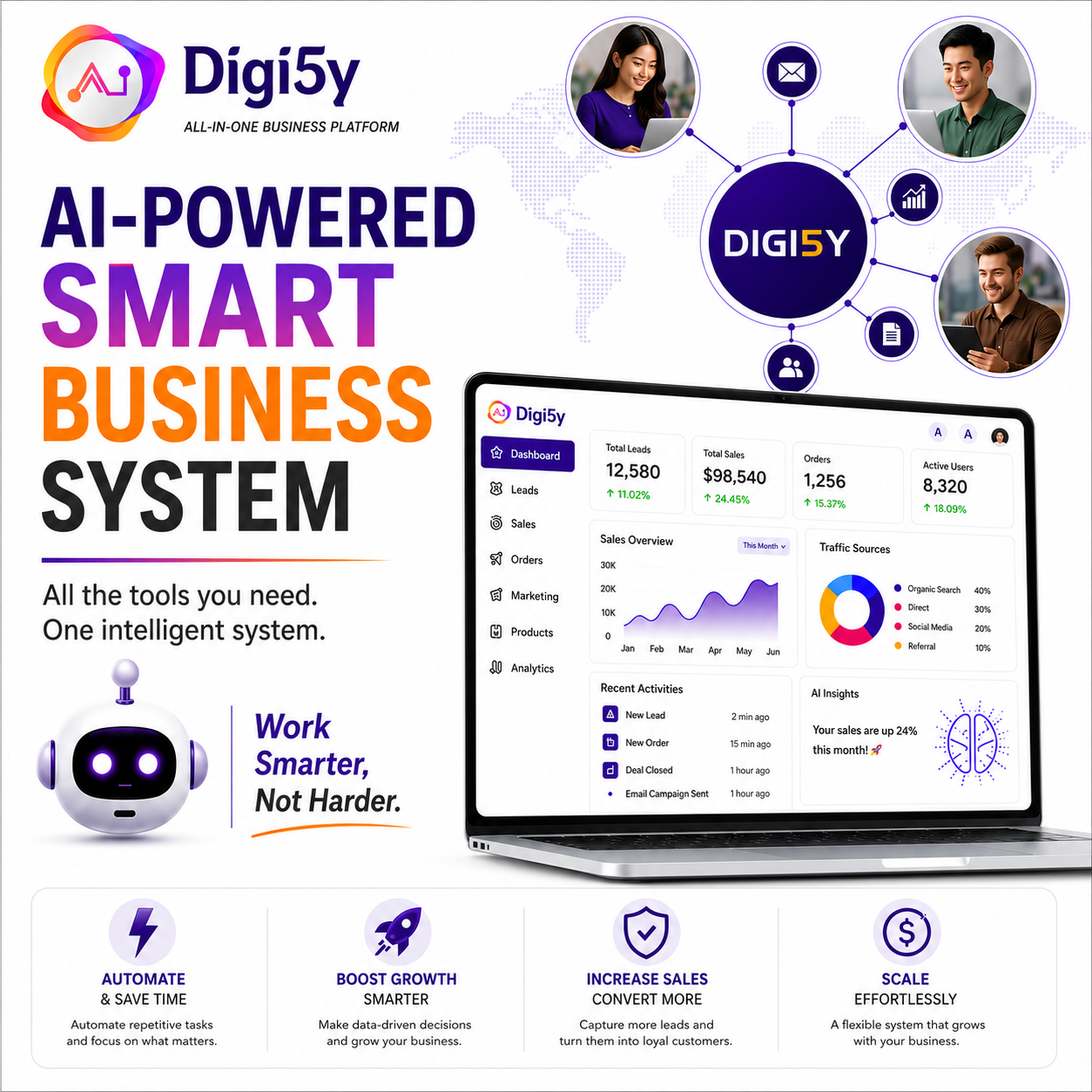
Alongside its AI employee team, DIGI5Y delivers the complete platform infrastructure your business needs to execute every growth strategy:
Full CRM with pipeline management, contact scoring, and activity tracking
Email and SMS marketing automation with behavioural triggers
Drag-and-drop funnel and landing page builder
Social media scheduler across all major platforms
Online reputation management and review automation
Advanced analytics dashboard with real-time performance data
GrowthScore™ - a 12-point digital health audit that shows you exactly where your business is losing leads and revenue
And for businesses that want the output without the management overhead: DIGI5Y's network of certified remote specialists, SEO strategists, paid ads managers, social media specialists, CRM architects, and more — are already trained on the platform and ready to deliver from day one.
Discover what DIGI5Y's AI Employees can do for your business:
→ Explore DIGI5Y AI Employee Agents
Start Your Free 14-Day Trial at digi5y.com →
No credit card required. No contracts. Fully operational in 14 days.
Published by DIGI5Y — Digitalise. Automate. Grow. | digi5y.com | AI Employee Agents
