You're Probably Paying for 8 Tools You Could Replace with One
Most small and medium-sized businesses are quietly overspending on software — often by hundreds of dollars every month without getting the efficiency, visibility, or control they thought they were buying. Discover why consolidating your tech stack into DIGI5Y is the most strategic operational move this year.
Key Takeaway for Business Owners
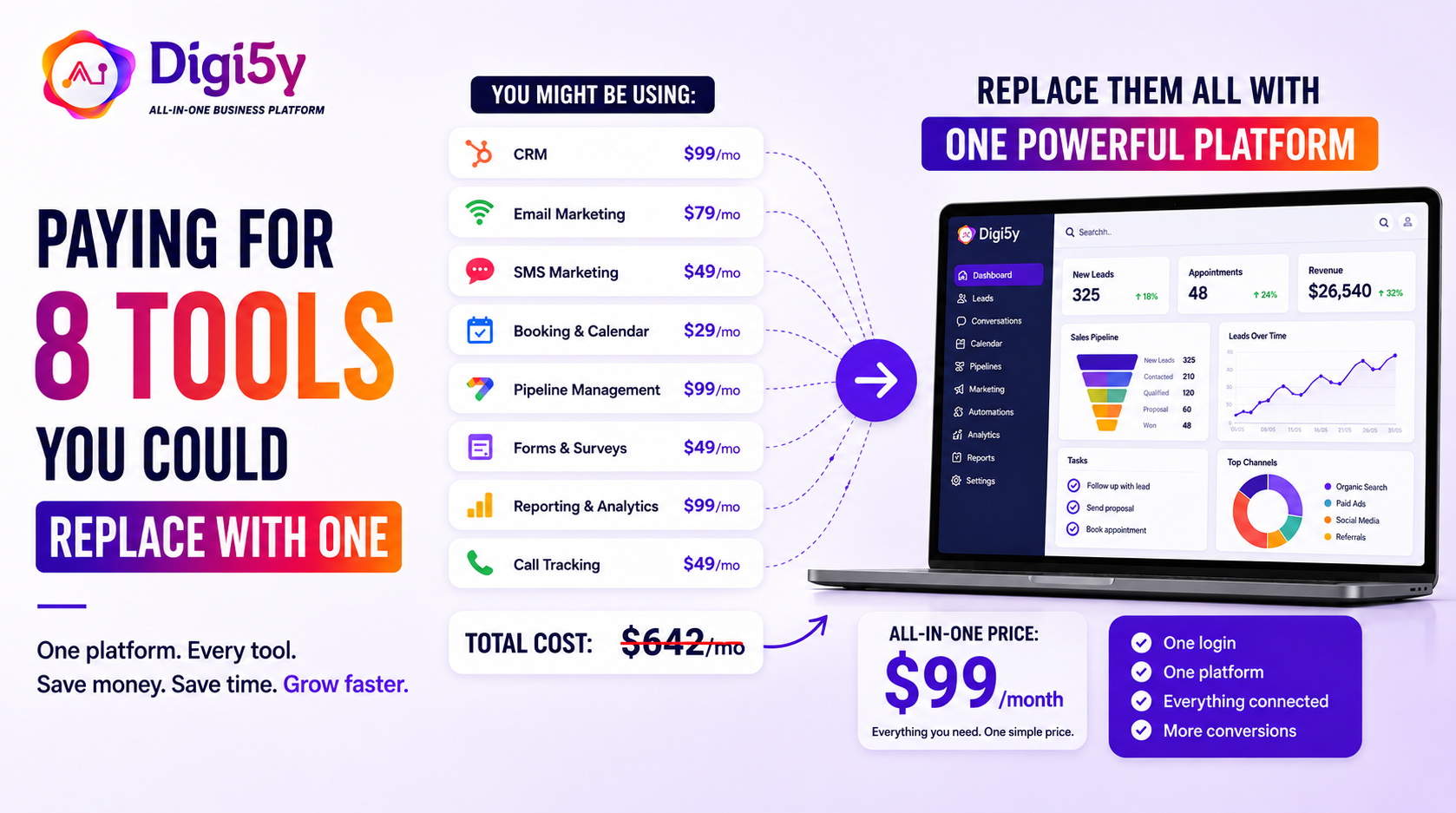
Most small and medium-sized businesses are quietly overspending on software — often by hundreds to thousands of dollars every month — without ever getting the efficiency, visibility, or customer control they thought they were buying. The core vulnerability is not just the standalone subscription price of eight disparate tools, but the compounding hidden tax of data silos, manual double-handling, broken zaps, and delayed follow-ups. By consolidating your CRM, omnichannel marketing, scheduling, reputation, funnels, and AI agents into a single unified platform, SMEs slash software spend by up to 85% while permanently eliminating pipeline friction.
Take an honest look at your credit card statement right now. CRM, email marketing, calendar booking, social scheduler, review manager, website builder, live chat, reporting dashboards. You are not just paying for eight distinct tools — you are paying multiple times for overlapping features and funding the silent operational drag that stalls your company's growth.
For the majority of modern SMEs, software costs land between $500 and $1,500 every single month before factoring in a single dollar of internal labour. Yet despite this relentless monthly outflow, these tools refuse to communicate natively. Customer records drift out of sync, sales reps copy and paste lead details into spreadsheets, marketing sequences miss crucial pipeline stages, and prospective buyers slip through the cracks at every juncture of the acquisition funnel.
📌 Core Diagnostic Takeaway
The Leak Between the Silos
The fatal issue in modern business software is not how many tools you subscribe to, but how much revenue, speed, and customer goodwill leaks out between the cracks every single day.
Figure 1: The Fragmentation Trap vs. The Unified Platform — Replace 8 disconnected monthly subscriptions ($642+/mo) with DIGI5Y's single engine ($99/mo).
The Anatomy of a Patchwork Tech Stack: How Fragmentation Creeps In
No founder or business leader sets out to build an erratic, fragmented technology stack. It happens incrementally over years through reasonable, isolated decisions. You first adopt a standalone CRM. Then you add a dedicated email newsletter tool because the CRM's broadcast feature feels basic. Next, you need self-service appointment scheduling, so you subscribe to Calendly. Shortly thereafter, your marketing contractor insists on Hootsuite for social queues, Birdeye for Google reviews, ClickFunnels for lead generation, Intercom for website visitor chat, and Databox to stitch reporting charts together.
Each individual tool purchase seems justifiable on its own merit at $49 or $99 per month. However, the compound operational penalty of eight disconnected software silos is devastating. When your CRM fails to communicate with your email automation, your team resorts to manual CSV exports. When appointment bookings fail to update lead statuses instantly, salespeople show up unprepared. When web forms and chat widgets operate on isolated databases, customers are forced to repeat their background information three times.
"Every disconnected tool introduces friction. Enough friction, and your growth engine quietly stalls while your overhead quietly compounds."
This fragmented patchwork inflicts four systemic commercial injuries upon your organisation:
- 1. Hostile Data Silos: Customer contact records, notes, and lifecycle history live across disparate tools in conflicting formats. Nobody in the organisation possesses a single, undisputed source of truth.
- 2. Crippling Operational Drag: Account managers and administrative staff waste between 5 and 15 hours every week logging into multiple web apps, copying data, re-keying invoices, and fixing broken webhook connectors.
- 3. Incoherent Customer Journeys: Automated messages fire out of sequence, follow-ups are delayed by hours or days, and channels deliver contradictory messages because no unified orchestration engine exists.
- 4. Blind Strategic Decision-Making: In the absence of end-to-end attribution, business owners cannot determine which ad campaigns, keywords, or sales reps generate actual cash collections versus vanity impressions.
💡 Practical SME Diagnostic
The Spreadsheet litmus Test
If your leadership team requires manual spreadsheets or external Zapier bridges to combine data from multiple tools just to answer basic customer acquisition and revenue questions, your tech stack is taxing your growth far more than you realize.
The Honest Financial Ledger: What the Average SME Pays Every Month
Below is the realistic software breakdown observed when growth-minded businesses consult DIGI5Y. While brand selections may vary slightly between HubSpot, ActiveCampaign, or Zoho, the recurring financial profile is strikingly uniform across professional services, medical clinics, construction trades, wellness centers, and e-commerce brands:
- Dedicated CRM (HubSpot, Salesforce Starter, or Zoho CRM): $50 to $200 / month
- Email Marketing & Automations (Mailchimp, Klaviyo, or ActiveCampaign): $50 to $170 / month
- Appointment Scheduling (Calendly Pro, Acuity, or OnceHub): $15 to $60 / month
- Social Media Scheduler (Hootsuite, Buffer, or Sprout Social): $50 to $120 / month
- Online Reputation & Review Generation (Birdeye, Podium, or ReviewTrackers): $200 to $450 / month
- Landing Page & Funnel Builder (ClickFunnels, Unbounce, or Leadpages): $49 to $197 / month
- Live Website Chat & Messaging (Intercom, Drift, or Zendesk Chat): $50 to $200 / month
- Business Analytics & Dashboard Reporting (Databox, Klipfolio, or Geckoboard): $50 to $150 / month
- Pipeline Management & Third-Party Zapier Webhooks: $30 to $100 / month
That totals between $495 and $1,410+ each month for basic operational plumbing — before counting extra user seat licenses, onboarding surcharges, and surprise tiers triggered whenever your contact list grows past arbitrary arbitrary subscriber limits. Crucially, scrutinizing these invoices exposes rampant feature overlap: your CRM has an email tool you never use because you pay for Mailchimp; your website builder has built-in booking you skip because you pay for Calendly; and your chat tool captures leads that must be manually keyed into your CRM.
- 8 separate monthly subscriptions ($500 - $1,500/mo)
- 8 logins, passwords, and 2FA authentications
- Fragile Zapier connections that break without warning
- Fragmented customer view split across 8 databases
- Slow manual follow-ups taking 4 to 24+ hours
- Steep learning curve and fractured training for new hires
- 1 predictable investment starting at just $99/mo
- 1 central master dashboard with role-based access
- Native internal event triggers without external webhooks
- Single unified customer timeline from ad click to review
- Autonomous sub-60-second omnichannel AI response
- One onboarding process and one dedicated support partner
The Transformational Reality of Consolidating into DIGI5Y
Now picture an entirely cohesive operational environment. Rather than forcing your team to navigate eight disconnected browser tabs, you operate from a centralized command center where every single customer touchpoint, communication log, and revenue milestone lives inside the exact same relational architecture. No CSV imports. No synchronization delays. No mystery about which record reflects reality.
DIGI5Y natively replaces your CRM, two-way SMS, email sequences, appointment calendars, social media planners, Google & Facebook review generation, website and funnel builders, live chat, conversational AI employees, and attribution dashboards inside one seamless interface. Because every feature shares the identical database, real-time automation operates without third-party integration baggage.
The Seamless Customer Journey in Action
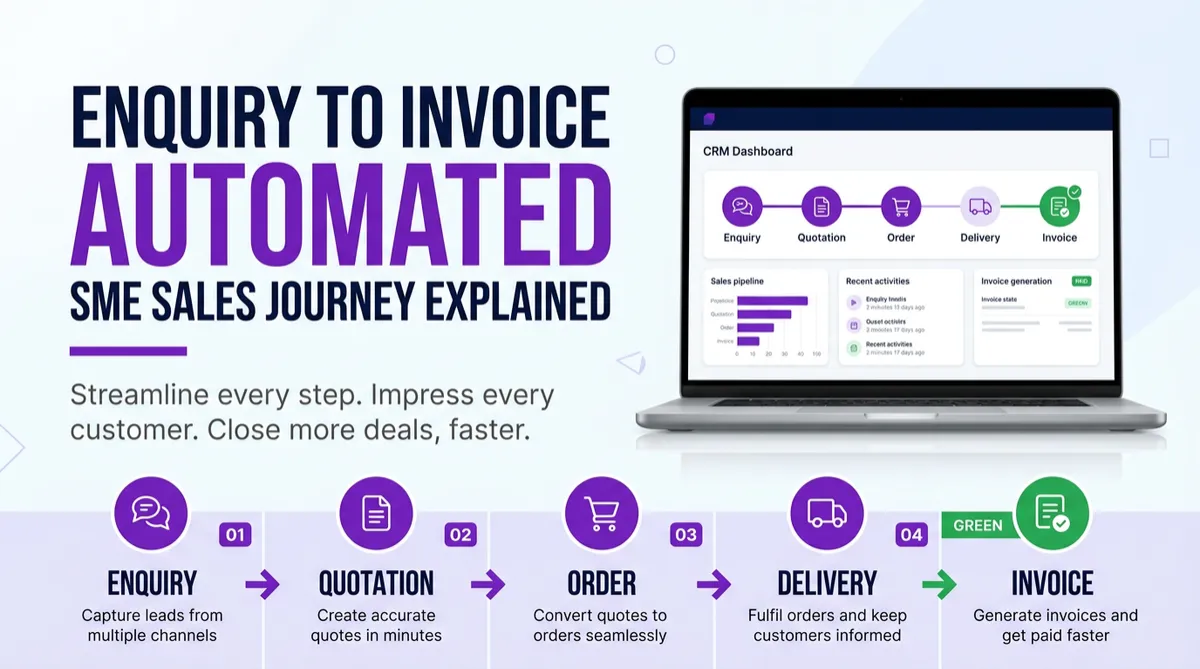
Here is how this unified architecture converts prospects into lifelong clients completely on autopilot:
- Stage 1 — Instant Multi-Source Ingestion: A prospective client clicks your targeted Facebook Ad, Google Search ad, or website widget and submits an inquiry. The lead is recorded instantaneously in DIGI5Y with UTM attribution intact.
- Stage 2 — Sub-60-Second Omnichannel Engagement: Within 45 seconds, an automated personalized WhatsApp or SMS message lands on the prospect's smartphone alongside a branded introduction email, maximizing speed-to-lead advantage.
- Stage 3 — Autonomous Calendar Scheduling: The message embeds a dynamic booking link synced directly to your staff's real-time availability, eliminating friction and back-and-forth scheduling delays.
- Stage 4 — Intelligent Pre-Meeting Nurturing: The CRM dispatches 24-hour and 2-hour reminder sequences with video briefs and location links, virtually eradicating typical 30% appointment no-show rates.
- Stage 5 — Automated Review & Reputation Compounding: The moment the appointment or service is marked completed in the pipeline, DIGI5Y automatically fires a polite review invitation via SMS, directing happy clients straight to your Google Business Profile.
- Stage 6 — Conversational AI Always-On Guard: If the prospect asks questions at midnight regarding pricing or prep instructions, DIGI5Y's AI agents answer accurately from your proprietary knowledge base and escalate VIP requests to human staff.
Notice what is conspicuously missing from this sequence: not a single employee had to export a spreadsheet, manually copy contact information, remember to send a calendar reminder, or draft a review request. The entire customer lifecycle executes automatically with zero dropped handoffs.
The Invisible Human Tax: Labor Drag That Dwarf Software Subscriptions
While cutting $500 to $1,000 every month in software bills provides immediate cash-flow relief, the true return on investment lies in liberating human capacity. Subscription fees represent only the visible tip of the software expense iceberg; the invisible bulk submerged beneath the surface is the labor your team wastes wrestling with disjointed systems.
When an employee earning an average $60,000 annual salary spends just sixty minutes each day logging into eight tools, transferring customer notes, reconciling email lists, and checking why a Zapier connection failed, the cold math is startling:
- 5 hours of lost productive focus per week
- ~20 hours of administrative friction per month
- ~240 hours of squandered payroll per year, per team member
- At a fully loaded rate of $30/hour, that represents $7,200 in wasted salary per employee every year
Multiply that $7,200 figure across a four-person sales and client delivery unit, and your business is hemorrhaging nearly $28,800 annually — simply paying capable staff to act as manual software routers. Moreover, every new hire requires weeks of training across eight confusing interfaces, creating fragile bottlenecks where only one specific person understands how the scheduling or email tool works.
"Every minute your skilled team spends managing software is a minute they are not managing customer relationships, closing qualified opportunities, or driving enterprise value."
Turning Tech Consolidation into an Unfair Strategic Advantage
Eliminating tool bloat is far more than an accounting cleanup. It fundamentally elevates the operational rhythm of your entire enterprise. Organizations that consolidate into DIGI5Y gain four decisive strategic moats:
- 1. Complete Operational Transparency: A single pane of glass reveals your pipeline velocity, active opportunities, cash collected, and client health metrics without requiring complex data modeling.
- 2. Lightning-Fast Agility: When you launch a new promotional campaign or seasonal offer, you build the funnel, configure the SMS triggers, link the calendar, and activate the AI agent in one afternoon instead of coordinating four software vendors.
- 3. Uniform Brand Experience: Clients encounter a polished, cohesive journey from the first touch to post-purchase support, building immediate trust and elevating brand prestige over fragmented competitors.
- 4. Seamless Scalability: Adding new sales reps or service locations requires zero additional tool subscriptions or technical re-engineering. You simply provision a new user in DIGI5Y and expand.
🎯 Executive Strategy Principle
Treat Your Stack as a Central Operating Engine
Stop thinking of software as an ad-hoc collection of apps purchased when problems flare up. Treat your technology infrastructure as a singular, unified nervous system engineered to acquire, convert, and retain clients systematically.
Your Practical 3-Step Action Plan to Consolidate Without Downtime
You do not have to disrupt active operations or cancel your tools overnight. High-performing companies follow a phased consolidation roadmap:
- Step 1 — Comprehensive Stack Audit: List every active SaaS subscription, monthly fee, user count, and primary business function. Flag overlapping features such as multiple form builders or email tools.
- Step 2 — Centralize Data in DIGI5Y: Export your master contact database and clean up tags. Import clean lists into DIGI5Y, establish your primary pipeline stages, and connect your domains and phone lines.
- Step 3 — Activate Core Triggers & Sunset Redundant Tools: Turn on DIGI5Y's automated speed-to-lead sequences, calendar booking, and review engine. Once verified, cancel the legacy standalone subscriptions one by one.
Frequently Asked Questions
Will migrating from 8 tools disrupt our daily client operations?
Not when handled systematically. With DIGI5Y, your core databases and pipelines are imported and configured in parallel while your old systems remain active. Once test inquiries flow smoothly through the unified system, you switch your web forms and calendar links seamlessly with zero customer downtime.
How much money does an average SME actually save with DIGI5Y?
The average client switching to DIGI5Y saves between $400 and $900 every month in direct software subscription fees, plus an estimated $600 to $1,500 monthly in reclaimed employee productivity and recovered missed opportunities.
Does DIGI5Y include AI capabilities, or is that an extra add-on?
DIGI5Y natively integrates conversational AI employees for chat and voice, automated text qualification, and intelligent prompt routing without requiring third-party plugins or convoluted API connections.
Can non-technical team members learn DIGI5Y easily?
Absolutely. Instead of learning eight different dashboards with conflicting terminology, your team masters a single, intuitive interface with full drag-and-drop workflow builders, visual pipelines, and localized customer support.
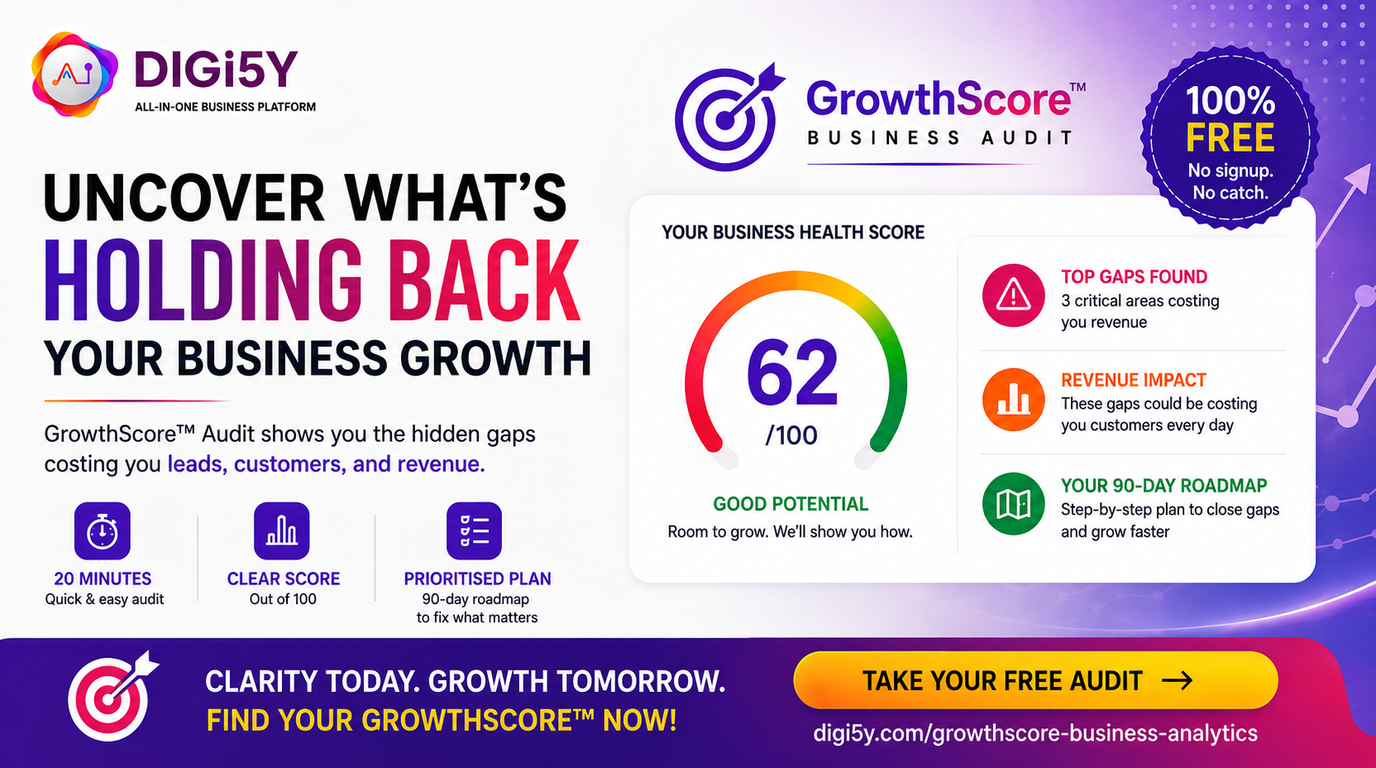
Stop hemorrhaging hundreds of dollars each month on disconnected software that slows your team down. Take the free 2-minute DIGI5Y GrowthScore™ Audit to discover exactly where your tech stack is leaking money and how consolidating into one AI-powered engine will accelerate your growth.
Read Next: Popular Growth Playbooks
Get the AI Edge Delivered Weekly.
Join 12,000+ founders and operators getting our freshest business automation software playbooks, AI employee agents news, and revenue-boosting hacks — straight to your inbox. No fluff. Just growth.