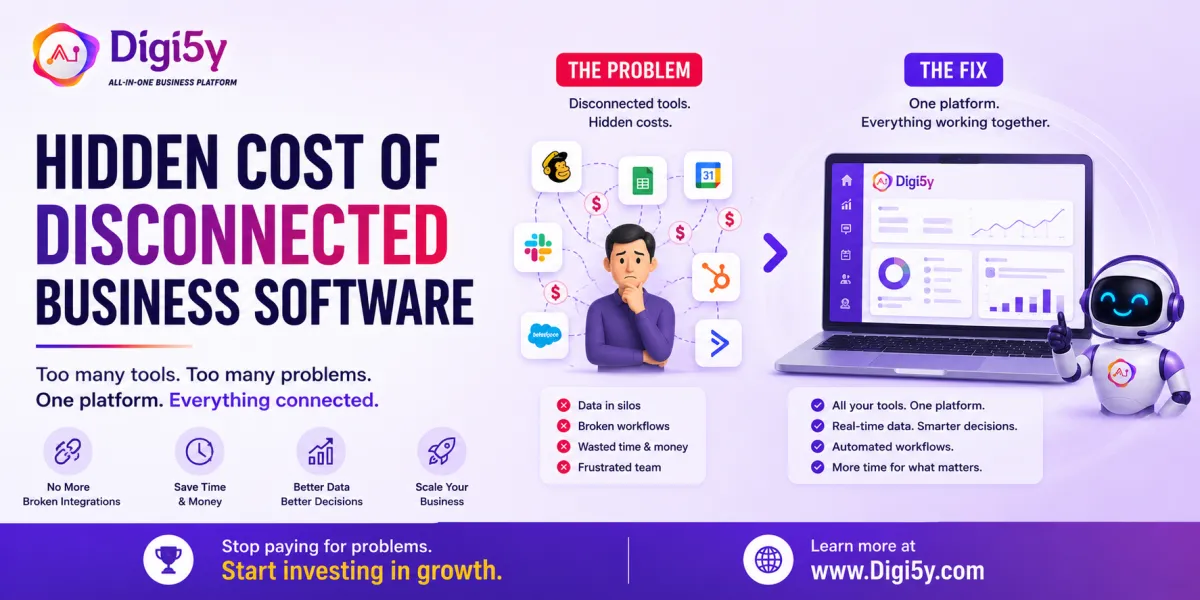
The Hidden Cost of Disconnected Business Software and How to Fix It
Most business owners know they are paying too much for software. What very few realize is that the subscription fees are only part of the story. The real cost of a fragmented tech stack is buried in hours lost, errors made, and decisions made on incomplete information.
The Obvious Cost: Monthly Subscriptions
Add up every software tool your business pays for monthly. For the average SME with a CRM, email tool, booking system, social scheduler, review platform, and website builder, the total is typically $500 to $1,400 per month. That is $6,000 to $16,800 per year, before any upgrades, add-ons, or third-party integrations.
The Less Obvious Cost: Data Entry Duplication
When your tools do not talk to each other, data has to move manually. A new lead captured in your CRM needs to be added to your email platform. A booking made through your scheduler needs to be recorded in your CRM. If one person spends just 30 minutes per day on manual data tasks, that is over 130 hours per year. At $25 per hour, that is $3,250 annually in labor doing work a connected system would do automatically.
The Most Expensive Cost: Decisions Based on Bad Data
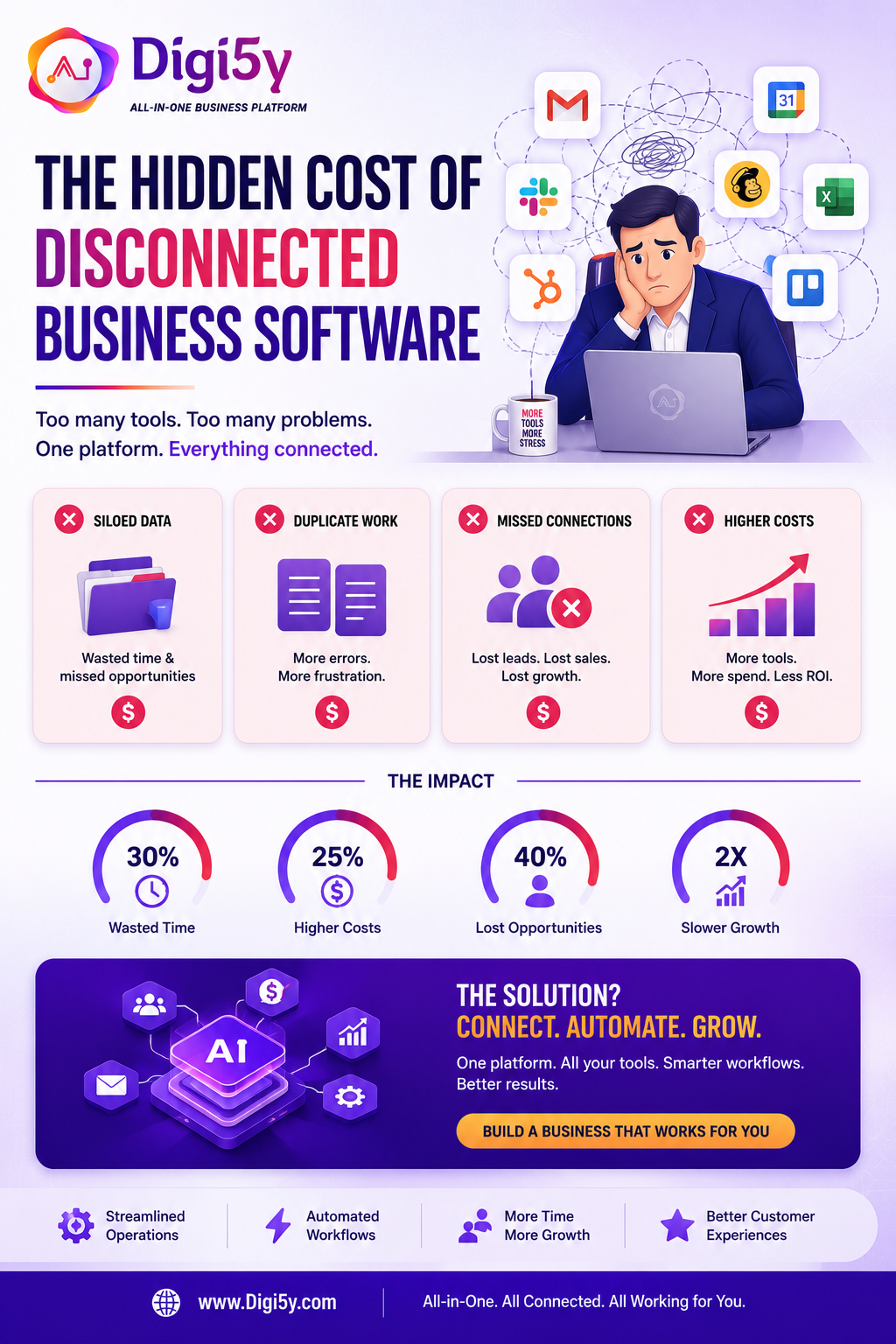
When your data lives in multiple systems, you never have a complete picture of your business. Your email tool shows open rates but not appointment bookings. Your CRM shows deals but not review scores. Your analytics shows traffic but not lead quality. Every decision made on partial information carries risk. Marketing decisions, hiring decisions, and pricing decisions, all made without the full picture. The cost of one wrong strategic call can dwarf your entire annual software budget.
The Integration Tax
Many businesses try to solve the disconnection problem with integration tools like Zapier or Make. These add another monthly cost, another layer of complexity, and another point of failure. When an integration breaks at 2am on a Saturday, your team finds out on Monday when a week of leads has not entered the CRM.
What Consolidation Actually Saves
When a business moves to a single connected platform like DIGI5Y, three things happen immediately. Subscription costs drop, usually by $400 to $900 per month. Data entry tasks disappear because information flows automatically between modules. Reporting becomes complete because every touchpoint is visible in one dashboard. The payback period for consolidation is typically 30 to 60 days. After that, it is pure savings.
How to Start the Transition
The first step is to audit your current stack. List every tool, its monthly cost, and the manual tasks required to keep it connected to your other tools. Then identify which of those tasks disappear when everything lives in one place. That exercise usually makes the decision simple.
See How Your Business Scores
Take the free DIGI5Y GrowthScore audit and discover exactly where automation can unlock growth in your business.