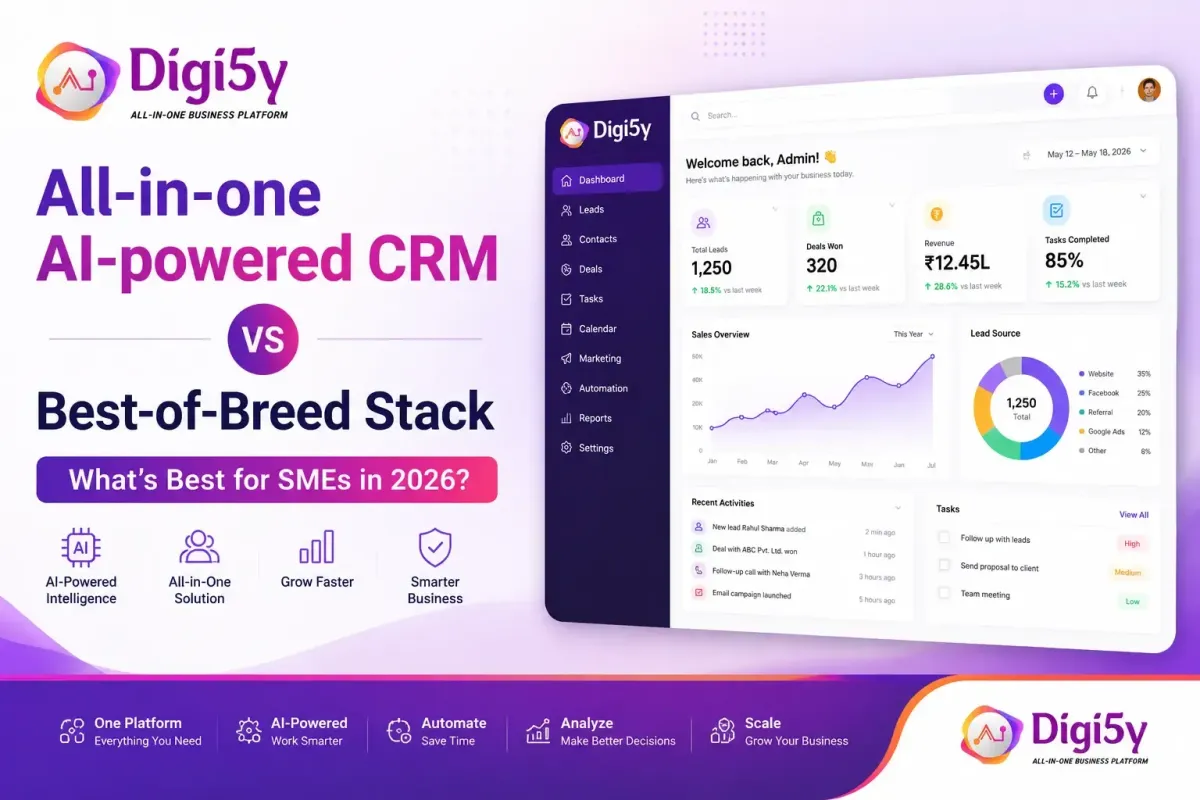
All-in-One AI-powered-CRM vs. Best-of-Breed Stack
For years, the standard advice for growing businesses was to pick the best tool for each job. Best CRM, best email tool, best scheduler, best analytics. The idea was that specialist tools outperform generalists in every category. That advice made more sense a decade ago. In 2026, the calculus has shifted, and most SMEs that followed it are now paying the price.
The Original Case for Best-of-Breed
The logic was sound at the time: if Mailchimp is the best at email and Salesforce is the best at CRM, why use a platform that does both at an average level? The problem is that this argument assumed integration would work seamlessly, that managing multiple platforms would not create significant overhead, and that the best tool in each category was justifiable in cost. For enterprise companies with large technical teams, that might still hold. For a 10-person SME, it rarely does.
What SMEs Actually Experience with Best-of-Breed
In practice, most SMEs using a best-of-breed stack have integrations that break regularly, data that is inconsistent across platforms, team members who use different tools differently, reporting that requires manual aggregation, and a monthly bill that has crept far beyond the original budget. The specialist tools are often more capable than needed, and their advanced features go unused because the team does not have time to learn them.
What All-in-One Platforms Offer in 2026
Modern all-in-one platforms have closed the capability gap significantly. A platform like DIGI5Y in 2026 offers CRM features that rival standalone CRM tools, email and SMS automation that competes with specialist marketing platforms, AI agents that go beyond anything available in most point solutions, booking and scheduling that matches dedicated tools, and reputation management and social scheduling included at no extra cost. The trade-off used to be that all-in-one meant average across the board. For the SME use case, that is no longer true.
The Real Advantage of Consolidation
The primary advantage of an all-in-one platform is not any individual feature. It is the connection between features. When a lead fills out a form, that data flows automatically to the CRM, triggers an email sequence, schedules a follow-up call, and updates the analytics dashboard. No integration required. No delay. No data loss. That connected flow is something a best-of-breed stack can only approximate, and usually at significant cost in both money and maintenance time.
Who Should Still Use Best-of-Breed
There are cases where specialist tools remain the right choice: businesses with very specific technical requirements, large enterprise teams with dedicated ops staff, or industries with compliance requirements that demand specialized software. For the vast majority of growing SMEs, the right answer in 2026 is an all-in-one platform, configured well, and built on solid automation foundations.
See How Your Business Scores
Take the free DIGI5Y GrowthScore audit and discover exactly where automation can unlock growth in your business.
